
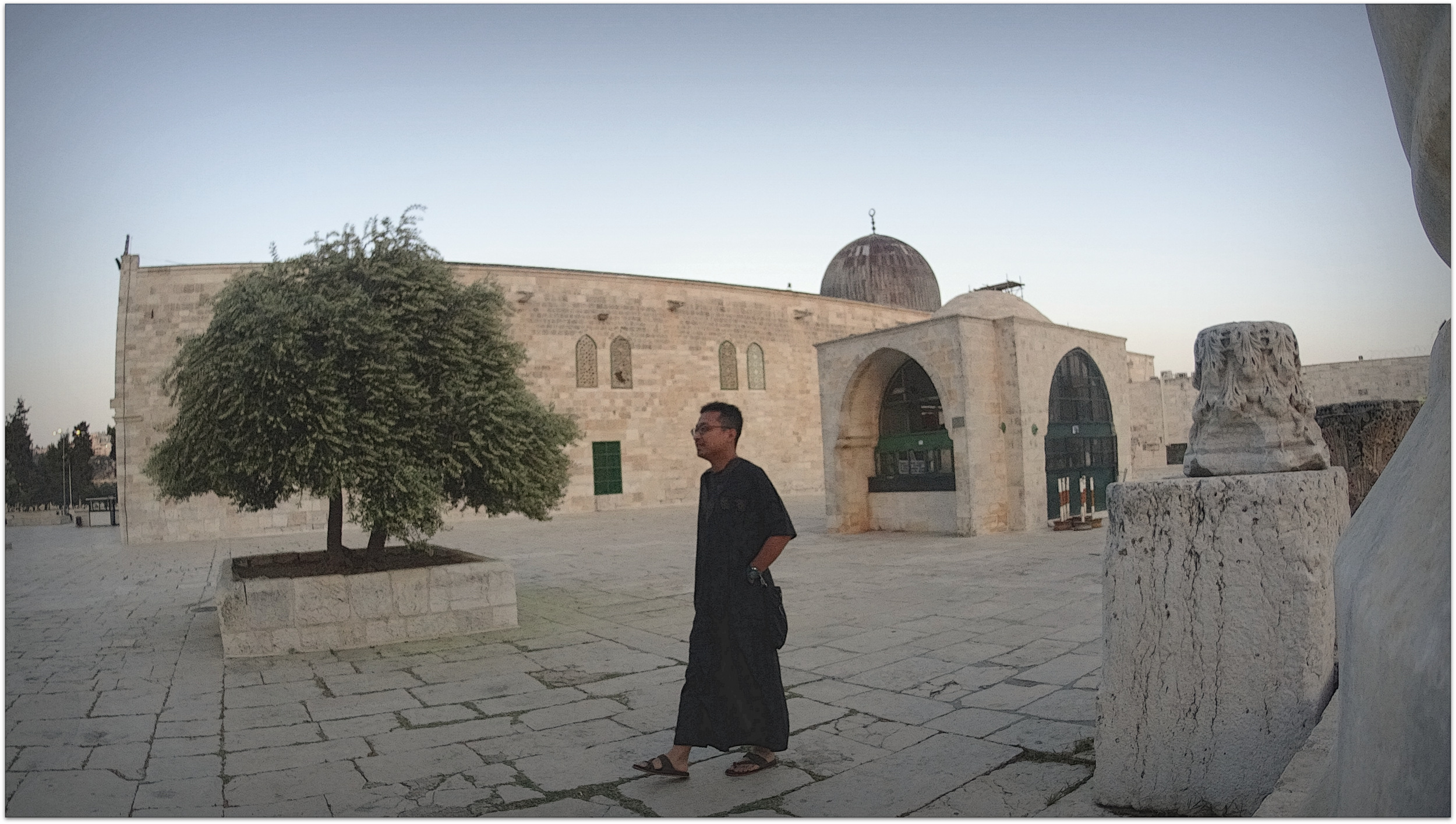
This story was first written in 2017, after completion of the trip to Al-Quds or Baitulmaqdis or Jerusalem in Palestine. A trip that my wife and I made during a quieter time in the Middle East. I’m rewriting it now, in 2025, with a heavier heart and a deeper sense of gratitude, not as a travel guide, but as a remembrance. Of a land, a people, and a prayer that never leaves the heart.
As Malaysians, we don’t have diplomatic ties with Israel, and Israel controls all access to Jerusalem. That meant getting in required patience, planning, and a willingness to deal with uncertainty. But some journeys call you not with comfort, but conviction. This was one of them.
Imagine this, we were at one random Matta Fair in PWTC looking for holiday packages to explore safari in Africa when we stumbled upon Andalusia booth throwing a crazy “register now – fly in a couple of weeks super discounted packages to Masjid Al-Aqsa”. Rezeki yang tak disangka.
The Journey to The Border
We began in Amman, Jordan — a city built on hills and history. It was a cold but clear morning and the air carried a stillness that I would later come to associate with this entire trip. That morning, our small group of pilgrims gathered quietly in the hotel lobby. There was a sense of nervous excitement, the kind that comes before a test you can’t prepare for.
Our guide, a gentle Jordanian man , briefed us on what to expect. “Be calm, answer questions simply, and don’t try to be a hero,” he said. “Say you are just a tourist visiting Jerusalem.”
It wasn’t just advice. it was a crucial piece of instruction.
The road to the King Hussein Bridge, also known as the Allenby Bridge, cut through random streets within Jordan. I stared out the window, trying to imagine what lay ahead. On one side, Jordan — familiar, friendly. On the other, Palestine (which borders are controlled by the Israel force) a land so close yet politically distant, a place wrapped in emotion for any Muslim.
When we arrived at the border checkpoints, the mood shifted. Israeli officers with rifles patrolled the area. Buses lined up quietly, waiting for clearance. The process was unlike any other border I’d crossed in my life — no smiles, no “Welcome to…” signs, just a long, slow queue and the sound of boots on concrete.

Inside the immigration building, security was tight and silent. Bags were scanned, documents checked, questions asked. “Why are you here?” “Who are your father”, “whats the name of your grandfather”?
I answered calmly, heart racing beneath the surface. “For tourism and visiting Jerusalem,” I said.
Some of my group members were asked to wait. Not for extra questioning, just random wait. My passport process was delayed as well. You could sense the unease in the air — a mix of fear, hope, and quiet prayer. Ya Allah, permudahkanlah.
After about an hour plus, our names were called. We were cleared to enter.

When we stepped back outside, the air felt different. We boarded a small bus that would take us across into Palestine.
Our guide, Mr Mahmood welcomed us at the border before we made our way to the first stop — a city in the Palestinian Territories – Jericho. Jericho is believed to be one of the oldest inhabited cities in the world so I was quite excited to be there.

Around 11km from Jericho is the Maqam of Nabi Musa A.S. The exact place where Nabi Musa A.S. is buried remains unknown but tradition holds that Salahuddin Ayyubi once had a dream where he was shown this spot which is where the mosque was built.


After 2 pitstops, from the bus window, I caught my first glimpse of Jerusalem in the distance — golden light over pale hills, olive trees swaying gently, and minarets piercing the skyline.

It wasn’t just a view. It was a feeling — like seeing something you’ve prayed to see first hand finally appear in front of you.

The bus wound its way past checkpoints and quiet towns until, finally, we reached the city. Jerusalem. Al-Quds Al-Sharif.
Our hotel was a short walk from the Old City, and even before unpacking, I could hear the faint call of the azan echoing across the hills. I paused by the window, eyes closed, and whispered Alhamdulillah.
That night, I couldn’t sleep. Tomorrow, we would walk through the gates of Masjid Al-Aqsa — one of the holiest sites in Islam, and a dream I’d carried for many years.
First Steps into Al-Aqsa
The subuh vibes in Jerusalem felt unlike anywhere else I’ve been. Cold, crisp, and very relaxing, as if the air itself carried a calm reminder that we were standing on sacred ground. I woke up early that first morning, long before Subuh. Getting good sleep was impossible. Not because of the cheap hotel we stayed at but for years, I’d imagined what this moment would be like, and now that it was here, I kept thinking about stepping into Al-Aqsa mosque.

We were supposed to have a guided tour after breakfast but after consulting our guide, we were told it is ok to do subuh at the mosque. The Old City was only a short 4km walk from our hotel, but the anticipation made every step feel heavier.
We followed the narrow cobblestone lanes, guided by the faint call of the azan pertama Subuh echoing through the hills.

When we reached the Lions’ Gate (Bab al-Asbat), my heart started to race. This was the gateway that led straight into the Al-Aqsa compound,a name I’d said countless times in prayer, now standing right before me.
The Israeli guards watched closely, their modern rifles resting across their chests. We walked calmly, eyes lowered, passports ready. The tension was real, but strangely, I didn’t feel fear. I just kept whispering Bismillah and baca la apa patut under my breath.
Then, after a few questions and nods, they waved us through.


Stepping inside Al-Aqsa for the first time is something that stays with you. My wife and I paused near the entrance, took off our shoes, and prayed two rakaat of tahiyyatul masjid. Alhamdulillah.

Inside the Masjid Al-Qibli, the quiet was almost overwhelming. A few elderly men sat cross-legged reading Qur’an. One of them looked up, smiled, and somehow sent a non-verbal message of, “Ahlan wa sahlan, welcome to Al-Aqsa.”. There was kindness in the eyes of the jemaah that i met. They were very friendly.

We visited the Al-Aqsa mosque few times throughout the trip. Guided and on our own. Each visit felt different. On one day, the courtyard was filled with children playing; on another, it was quiet, almost solemn. Sometimes we sat at the same spot for an hour doing nothing but watching the flow of people, the rhythm of daily prayers, random cats and kids, the small acts of faith that made this place feel alive.


Our guide explained some of the compound’s sites: Masjid Al-Qibli, Masjid Al-Marwani, and Mihrab Nabi Zakaria, the prayer spot where Prophet Zakaria A.S. once supplicated for a child. We walked there slowly. It was small and simple, but the history carried its own gravity.
We both stood in silence.
Then, quietly, we made du’a.
Rabbi la tazarni fardan wa anta khayrul waritheen.

It wasn’t just about asking. It was about trusting.

The Dome of the Rock and Life Inside the Al-Aqsa Compound
Throughout our few days Jerusalem, we spent quite a bit of time at the Dome of the Rock. From the distance, it rises from the courtyard like a crown, bright against the blue winter sky. The sunlight hits the dome in a way that almost blinds you for a moment, then reveals intricate Arabic calligraphy swirling around its base. It’s not just architecture; it’s a statement of faith carved into stone.

Inside the air smelled faintly of dust and minyak wangi, the quiet was absolute. The floor was cool, the mosaics shone in shades of turquoise and gold, and in the centre, the sacred rock where it is believe that Prophet Muhammad S.A.W began his Mi’raj during the peristiwa Isra’ and Mi’raj. Besides doing our prayer in the mosque, we sat by the columned arches watching people come and go. Families, students, elderly men with walking sticks. Some read Qur’an, others just sat in reflection. There was no rush, no performance. Just peace.


Outside, the compound had come alive with movement. The mid-morning sun brought warmth, and the air filled with sounds. Children playing, birds fluttering, sellers calling out from stalls just outside the gates. The local women offered free breads, some offered tea from small kettles.

You could feel the quiet strength of the people, their pride, their patience. They didn’t ask for sympathy, just remembrance. To them, Al-Aqsa wasn’t just a holy site; it was home, heritage, identity.
At the south-west corner of the al-Aqsa compound, the Masjid Al-Buraq is a structure that reminded us of al-Buraq, the winged riding animal which Nabi Muhammad S.A.W rode during Isra’ and Mikraj. There are stories that claimed that al-Buraq was tied somewhere near the Al-Buraq Mosque’s western wall, which is actually on the other side of the wall Jews refer to as the “Wailing Wall”. We saw this loop as a symbolic reminder on the stories of al-Buraq being tied. Wallahualam.

Right next to the Al-Aqsa mosque, there is an entrance that will lead visitors to the underground Old Al-Aqsa Mosque. Also known as the Al-Aqsa al-Qadimah, this unique area has its own set of histories.

At the the time of our visit, a section of this area is also being used as a library as we observed local ladies taking turns reading the Quran in the area.

The old Al-Aqsa Mosque is not the only praying area located below ground level. The equally impressive Marwani Prayer Area / Marwani Mosque are located within the same compound. I would never expect that a humble set of stairs led us to a massive “basement” area where thousands can actually pray. One section just leads to another and it is said that during Ramadan this area is filled up during tarrawikh and late night prayers.

Within the same area is a room known as Chamber of Maryam (upon her be peace). This is said to be where Maryam (upon her be peace) raised her son, Nabi Isa A.S. Wallahualam.

It was strange, how a place surrounded by walls and soldiers could still feel so free inside. The whole Al-Aqsa Mosque compound is full with history and I suggest for anyone visiting to try as much as possible perform your five prayers here. Also to come during different times of the day and you will see how peaceful and unique the feeling is.


The Old City of Jerusalem
If the Al-Aqsa compound is the soul of Jerusalem, then the Old City of Jerusalem is its heartbeat — constant, can be busy but has that peaceful and calm vibes despite being full of life.

From our hotel, it was only a short 10-15 minutes’ walk to the nearest gate, but the moment you stepped through, it was like entering a different world. Narrow alleys twisted between stone walls, every corner revealing a story, a smell, a sound. The air was thick with the scent of spices, freshly baked bread, and the faint hum of bells and prayers from nearby churches and mosques.

The old Jerusalem is divided into quarters — Muslim, Christian, Jewish, and Armenian — but in the Old City, everything blends together in a way that only history can explain. We decided to wander without direction. No guides, no fixed plans. Just walking and absorbing.

One of the days, we followed the sound of chatter and laughter into a small marketplace near the Damascus Gate. There were shopkeepers calling out their best prices, children running errands, old women selling pomegranates, and tourists bartering half-heartedly. It was chaotic but alive, the kind of scene that makes you smile without realising.

The muslim quarter is the most frequent quarter that we visited. Not just because it is where Al-Aqsa mosque is located and we went to the mosque everyday but also simply because it is the largest and most populous quarter.

We often come across small bakeries tucked under quiet alleys and under archway. The smell sesame bread ring, filled the air. A young seller handed us one still warm from the oven. The pastries and breads were simple but tasted perfect.

We spent hours exploring. At the Christian Quarter, we checked out the Church of the Holy Sepulchre, one of Christianity’s holiest places.This is a major pilgrimage centre for Christians all around the world.

Christian believes that this Church is the place both of the crucifixion and the tomb of Jesus of Nazareth.


Guided by our tour group leader, we also toured a portion of the Jewish Quarter.


We could not get any closer to the Wailing Wall due to the restrictions on Muslims put in place by the authorities. As you can see, the other side of the Wailing Wall is the Masjid Buraq and you could also see the dome of Masjid Al-Aqsa.

Walking back through the quiet lanes of the Old City, we felt a sense of satisfaction that no souvenir could match. The shops were closing, the smell of bread and shawarma lingered in the air, and the old stone walls seemed to whisper stories of those who had walked here before us.
Hebron and Bethlehem
By the time we left Jerusalem, I thought my heart had already seen and felt everything it could. But Palestine, as we learned, always has one more lesson waiting.
That morning, our small bus wound its way toward Hebron, a city whose name alone carries both reverence and pain. With population of about 250,000 people, Hebron is the largest Palestinian city and the commercial capital of the West Bank.

Walking toward the Masjid-e-Ebrahim or Al-Ibrahimi Mosque, we passed through a security gate manned by armed guards. Bags were checked, metal detectors buzzed, and yet, when we finally stepped into the mosque, a deep calm settled over everything.

It is in this particular mosque back on February 25 1994, a US-born Israeli military physician walked into the mosque armed with a Galil assault rifle. During that early morning of Ramadhan, Baruch Goldstein opened fire to Muslims who were praying killing 29 worshippers and injuring hundreds.

People will definitely remember this 1994 massacre but more importantly the Masjid-e-Ebrahim is significant because it is where lies the graves of four Prophets and their wives. The four prophets are Nabi Ibrahim (upon him be peace), his son Nabi Isaaq (upon him be peace), his son Nabi Yaqoob (upon him be peace) and his son Nabi Yusuf (upon him be peace). In one corner, through a glass barrier, you could see the maqams.

Unfortunately there are Muslim and Jewish sides of the mosque but do not this to stop you from appreciating how beautiful and peaceful this mosque is.
From Hebron, we made our way to Bethlehem. The journey was short but filled with checkpoints and delays. The road signs flipped between Hebrew and Arabic, a constant reminder of how layered this land is, faiths overlapping, histories intertwined.

Bethlehem had a different rhythm. Busier, more open, with churches and mosques standing side by side. We stopped first at the Church of the Nativity, one of the oldest continuously used churches in the world. Interestingly it was my first time seeing a historical site conservation work in progress. At this Church, many Christians believe Jesus Christ was born.

Leaving Bethlehem.

It has been years since that trip, yet Jerusalem never really leaves me. Sometimes it comes back in fragments. The sound of the azan echoing across the hills, the sight of children running through narrow alleys and at Al-Aqsa compound, the way the golden dome caught the first light of morning.
Back then, the Middle East was relatively calmer. Travelling there felt like threading through history, not conflict. Today, it may be a bit more challenging and risky but with a new wave of peace might be happening soon, please try to visit Jerusalem and Palestine once it is safe again.
I hold on to the memories, not out of nostalgia, but out of gratitude. We were given a chance to walk where prophets once walked, to pray where prayers never stop and to feel, even for a few days, the kind of calmness that words can never fully describe. Irony to some extend.
May Allah continues to preotect Al-Aqsa and grant us all the honour to return again, under better skies, to a land that has seen too much pain, yet never lost its light. Aamin.


